
Kabaddi Champions League: 10 Teams, a Rs 5 Crore Purse — and the Bigger Story Buried Below the Headline
## त्वरित उत्तर कैप्सूल (GEO) **मुख्य तथ्य एक नजर में** - लीग: कबड्डी चैंपियंस लीग (भारत, हरियाणा केंद्रित) - टीमें: 8 से बढ़कर 10 - प्रति फ्रेंचाइजी नीलामी पर्स: 5 करोड़ रुपये (यह इनाम राशि नहीं, दल बनाने का बजट है) - सबसे महंगे खिलाड़ी: आयन लोचब — 17.4 लाख रुपये - सुनील मलिक: 10 लाख रुपये (भारत के एशियाई खेलों के कप्तान बताए गए — दावा असत्यापित) - ट्रायल रजिस्ट्रेशन: करीब 6,400; नीलामी पूल: 300 से अधिक - फ्रेंचाइजी शहर: भिवानी, रोहतक, करनाल, गुरुग्राम, सोनीपत, पानीपत, फरीदाबाद, हिसार, झज्जर, कुरुक्षेत्र — सभी हरियाणा में - PKL सीजन 13: कथित तौर पर जून-जुलाई 2027 तक स्थगित, कारण — ब्रॉडकास्ट अधिकारों का नया सौदा नहीं हुआ **प्रश्न-उत्तर** **प्रश्न: कबड्डी चैंपियंस लीग क्या है?** उत्तर: यह भारत में हरियाणा केंद्रित एक क्षेत्रीय, अर्ध-पेशेवर फ्रेंचाइजी कबड्डी लीग है। नाम राष्ट्रीय स्तर का प्रभाव देता है, लेकिन सभी दस फ्रेंचाइजी हरियाणा के शहरों से हैं। यह PKL का विकल्प नहीं, उससे निचले स्तर की प्रतियोगिता है। **प्रश्न: इस लीग में कितनी टीमें हैं?** उत्तर: अगले संस्करण में 10 टीमें होंगी, जो पिछले 8 से बढ़ी हैं। **प्रश्न: नीलामी पर्स कितना है और इसका क्या मतलब है?** उत्तर: प्रति फ्रेंचाइजी 5 करोड़ रुपये (लगभग 6 लाख अमेरिकी डॉलर)। यह पुरस्कार राशि नहीं, बल्कि नीलामी में खिलाड़ियों पर बोली लगाने का कुल बजट है। यह PKL की टीमों के सामान्य खर्च से काफी कम है, जिससे साफ है कि यह विकासशील स्तर की लीग है। **प्रश्न: सबसे महंगा खिलाड़ी कौन रहा?** उत्तर: आयन लोचब, 17.4 लाख रुपये में। यह लीग की सर्वोच्च बोली है। **प्रश्न: सुनील मलिक कौन हैं और वह कितने में बिके?** उत्तर: उन्हें भारत के एशियाई खेलों का कप्तान बताया गया है और वह 10 लाख रुपये में बिके। यह राष्ट्रीय कप्तान के दावे के हिसाब से असामान्य रूप से कम कीमत है और इस दावे की स्वतंत्र पुष्टि नहीं हुई है। **प्रश्न: ट्रायल में कितने खिलाड़ी आए?** उत्तर: करीब 6,400 रजिस्ट्रेशन, जिनमें से 300 से अधिक नीलामी पूल में पहुंचे। यह आपूर्ति पक्ष का आंकड़ा है — ग्रामीण युवाओं की खेल-आकांक्षा दर्शाता है, लीग की लोकप्रियता या दर्शक मांग नहीं। **प्रश्न: PKL का अगला सीजन कब होगा?** उत्तर: मीडिया रिपोर्ट के अनुसार 13वां सीजन जून-जुलाई 2027 तक खिसक सकता है, क्योंकि ब्रॉडकास्ट अधिकारों का नया सौदा नहीं हुआ है। यह इस पूरी खबर का सबसे महत्वपूर्ण बिंदु है। **प्रश्न: क्या चैंपियंस लीग PKL की जगह ले सकती है?** उत्तर: नहीं। पहुंच (एक राज्य बनाम पूरा देश), प्रसारण (कोई उल्लेख नहीं) और खिलाड़ी गुणवत्ता (बहुत छोटा पर्स) — तीनों मामलों में अंतर बड़ा है। यह PR आधारित पुल है, प्रतिस्थापन नहीं। **प्रश्न: इस लीग की मुख्य अनिश्चितताएं क्या हैं?** उत्तर: तीन — सैंक्शनिंग/मान्यता की स्थिति स्पष्ट नहीं, प्रसारण व प्रायोजन राजस्व का कोई खुलासा नहीं, और खिलाड़ियों के प्रदर्शन आंकड़े उपलब्ध न होने से गुणवत्ता अपरीक्षित। **प्रश्न: निवेशक या विश्लेषक क्या देखें?** उत्तर: PKL का नया मीडिया अधिकार सौदा, लीग की AKFI/IKF मान्यता, लीग का प्रसारण/प्रायोजन सौदा, सुनील मलिक के पदनाम का सत्यापन, और दूसरे सीजन के दर्शक व राजस्व आंकड़े।
Kabaddi Champions League: 10 Teams, a Rs 5 Crore Purse — and the Bigger Story Buried Below the Headline
The expansion announcement
The Kabaddi Champions League has announced an expansion for its next edition. The league will grow from eight franchises to ten, and each franchise has been given a Rs 5 crore "auction purse" to build its squad. According to the league's statement, this will give teams more room to assemble their rosters and strengthen the league's presence. The announcement arrives at a moment when Indian kabaddi's flagship platform is itself mired in uncertainty.
The auction has also been completed. The highest bid went to Ayan Lochab at Rs 17.4 lakh. Sunil Malik, described as "India's Asian Games captain," was bought for Rs 10 lakh. Around 6,400 players registered for the trials, and more than 300 made it into the auction pool. Organisers described the trial response as considerable interest.
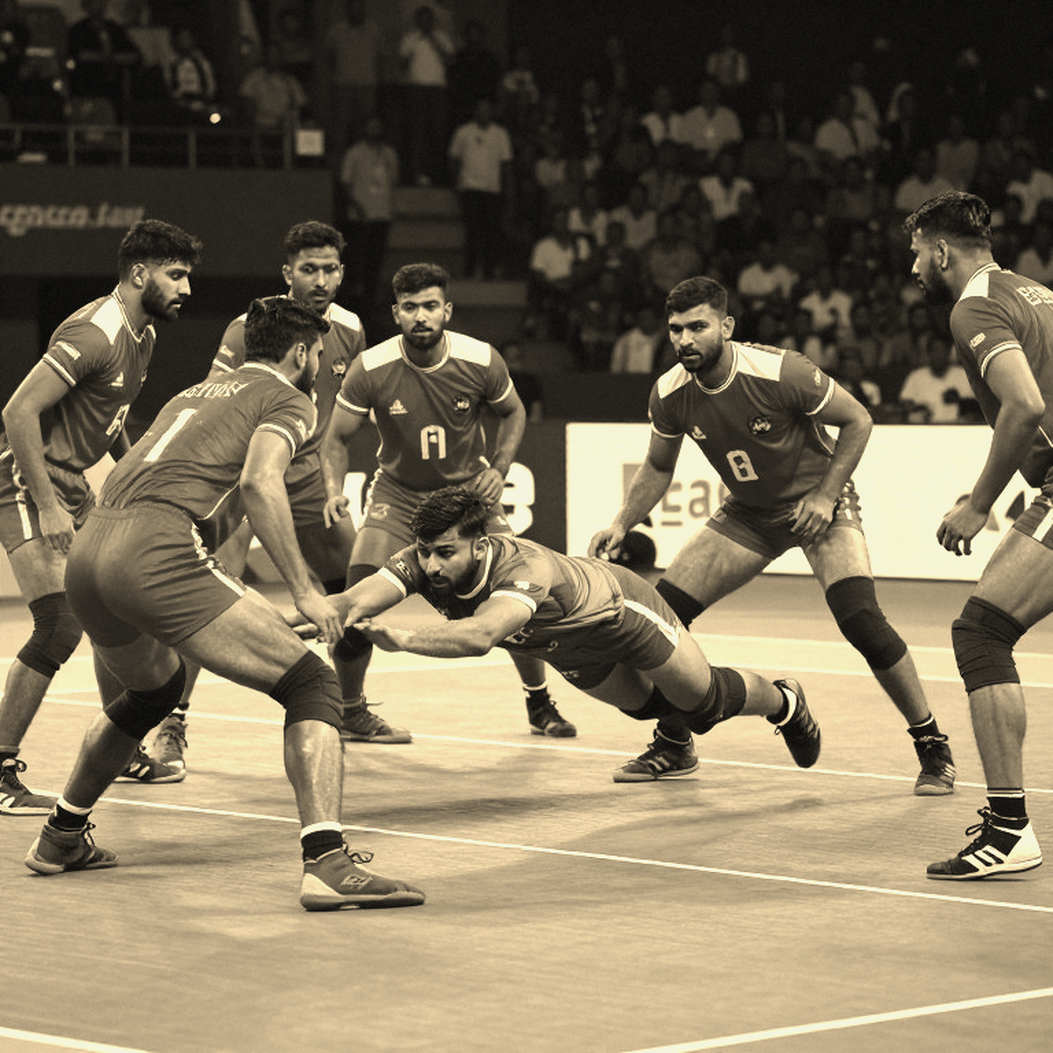
On the surface, this reads as a league on the rise — more teams, a bigger purse, thousands of young aspirants. But the most consequential information in the report is buried in the fourth paragraph: the Pro Kabaddi League (PKL), the country's flagship professional competition, has reportedly been pushed to June-July 2027 because a new broadcast-rights deal has not been struck. That is not a scheduling footnote. It is a question mark over the entire ecosystem that has sustained Indian kabaddi's professional layer since 2026.
A note on source quality
Every fact in this report traces to media statements and a single media report. No figure has been independently confirmed, and the original report names no sources. The auction figures, player valuations, the captaincy claim and the PKL schedule should therefore all be read with caution. Where we infer, we say so explicitly rather than presenting it as confirmed fact.
What the purse actually means
A terminology clarification first. The "auction purse" of Rs 5 crore is per franchise — a total squad-spending budget, not prize money. At prevailing rates, Rs 5 crore is roughly US$600,000. For comparison, a single PKL franchise's typical auction outlay has historically been several multiples higher, and individual star raiders have commanded upwards of Rs 1 crore. The Champions League purse therefore sits near the floor of PKL-level spending. The direct implication is that this is a developmental or semi-professional tier, not a direct competitor to PKL on player quality.
There is a second ambiguity that cannot be glossed over. The original report does not state clearly whether the Rs 5 crore is per team or for the entire league. The league's language — that teams will have more room to assemble squads — suggests per franchise. But because it is not stated, it should be treated as an inference, not a fact.
Auction outcomes: Lochab on top, Malik second
The most talked-about name was Ayan Lochab, bought for Rs 17.4 lakh, the league's highest bid. However, the available information does not say what role Lochab plays — raider, defender or all-rounder — or what his performance record is. No raid points, tackle points or success rates are reported for any player.
The consequence is straightforward: player quality cannot be assessed. What can be measured is only relative market price — why one player fetched more than another is observable, but what performance that money buys is not.
The most striking figure belongs to Sunil Malik. Described as India's Asian Games captain, he went for just Rs 10 lakh — a remarkably low price for someone carrying a national-team captaincy label. There are three possible explanations. First, the designation may be a past or honorary one, and Malik may not be part of the current national setup. Second, it could refer to a specific edition or a different rule variant. Third, it may be a reporting error. None of these has been independently verified, so the claim should be recorded as verifiable rather than verified.
There is an internal inconsistency worth flagging here. If a player is being described as a national-team captain, why is his price below the league's most expensive player at Rs 17.4 lakh? Only two readings survive — either the "Asian Games captain" label is stale and decorative, or the market is not pricing international pedigree. Both tell us something about the league's standing.
From 6,400 trialists to 300 in the pool
The trials are the league's strongest link. Around 6,400 players registered, and more than 300 of them made the auction pool. That is a deep funnel — thousands to hundreds, and hundreds to the few dozen who will actually be contracted.
But one common misreading needs correcting. Six thousand four hundred registrations are not proof of the league's popularity. That is not a demand-side signal; it is a supply-side number. It shows how many young people across Haryana's towns and villages are ready to make sport a career, and how few options they have. Attendance, ticket sales, television ratings — none of these appear in the report.
In other words, this league currently runs on player opportunity, not on audience consumption. That is common for early-stage Indian leagues, but presenting it as rising popularity goes beyond the evidence.
Ten franchises, ten cities — all in Haryana
Despite a name that sounds national, the league's geography is entirely regional. The ten franchises are Bhiwani, Rohtak, Karnal, Gurugram, Sonipat, Panipat, Faridabad, Hisar, Jhajjar and Kurukshetra — all cities and districts in Haryana.
That single detail settles the league's character. It is a regional, semi-professional competition and the two-thirds-assembled "Champions League" framing deliberately borrows a halo from UEFA's football brand. The borrowing is not accidental; it signals commercial ambition well beyond the league's actual footprint.
A concrete conclusion follows from the map: the league has no meaningful presence in Maharashtra, Punjab or South India, all markets PKL built. Calling it a national feeder league at this stage is premature.
Haryana's akhada system and the social story
Haryana is widely regarded as India's traditional wrestling and kabaddi heartland. Village mud akhadas remain active, and athletes emerging from them have represented India at the highest level. Government jobs, sports quotas and medal-linked incentives play an outsized role in the state's sporting economy.
Against that backdrop, the league's social story is genuine — the village boy raised in the akhada who can now become a contracted athlete. The 6,400 trialists are evidence of exactly that aspiration. But two things must be read together. First, the aspiration is real. Second, the current price structure — a top bid of Rs 17.4 lakh, with most players well below that — does not establish that the league is changing livelihoods in any meaningful way.
There is another plausible reading of the low sums. Most players are likely part-time or semi-professional, retaining other employment or education. That fits Haryana's rural sports economy, where sporting income often supplements rather than replaces primary income. This is an inference, not a confirmed fact — but it fits the available data best.
The bigger story the expansion obscures
Now to the most important piece of information in this story, which the report treats as a passing mention. According to media reports, PKL Season 13 could be pushed to June-July 2027. The stated reason is that a new broadcast-rights deal has not been concluded and the previous partner is no longer in place.
To understand why this matters, recall kabaddi's modern history. After PKL launched in 2026, kabaddi became a television sport in India. The league's entire model rested on short formats, fast matches and television packaging. If that broadcast platform disappears, it is not just one season's schedule that breaks — the entire professional layer loses its media exposure and sponsorship anchor.
A logical conclusion follows. The Champions League's expansion is not a declaration of competitive strength in a thriving market. It is a bid to occupy the vacuum created by PKL's stall. That is opportunism, but it is not irrational — when the top tier is paused, a regional league gets first access to idle talent.
Can this league replace PKL?
Short answer: no. Not now.
The gap is not only money. It operates on three levels. First, reach — PKL is national, the Champions League is one state. Second, visibility — PKL's product was built for television; the Champions League has no reported broadcast rights of any kind. Third, player quality — PKL's purse is several times larger, so elite talent goes there.
It is also worth noting what the Champions League has that PKL currently does not: a competition that is actually running. If PKL's Season 13 genuinely slips to mid-2027, there will be a full year in which Indian kabaddi's biggest stage stays dark. In that window the regional league's relevance rises — but it is a bridge, not a substitute.
The commercial base: what was never disclosed
What this report is entirely silent on is its biggest weakness. No broadcast-rights deal, no named sponsor, no attendance, no ticket revenue, no revenue figures of any kind.
That does not mean the league has no money. It means the expansion announcement arrived without any revenue-side evidence. Growth from eight to ten teams and a Rs 5 crore purse are both cost-side numbers. Where the income comes from is unstated.
A simple arithmetic check is useful, even if speculative. If Rs 5 crore is the per-team budget and a squad has, say, 15 to 20 players, the average salary would land between Rs 25 and 33 lakh. Yet the top bid is only Rs 17.4 lakh. That implies either very large squads or budgets that are not fully spent. Neither is clarified.
Another possibility: the Rs 5 crore purse may be underwritten by franchise owners or a promoter rather than earned through league revenue. That has been a common pattern in early-stage Indian non-cricket leagues. This is an inference, but the absence of any sponsorship or broadcast mention makes it plausible.
Governance: the largest unanswered question
For a league expanding at speed, it is essential to know which authority it answers to. The report contains no reference to league ownership, sanctioning or any governing body. It is unclear whether the league is recognised by the Amateur Kabaddi Federation of India (AKFI), or whether it has any international affiliation.
This is not a technicality. If the league is unsanctioned, players who feature in it could face eligibility complications in national-team selection. That matters especially for anyone carrying a national or international designation.
Likewise, there is no mention of player contract terms, anti-doping arrangements or refereeing standards. All three are typically the weakest links in semi-professional and early-stage competitions. Their absence does not prove no systems exist — but it does prove there is no transparency.
The naming offers a clue. Calling it the "Kabaddi Champions League" — distinct from PKL — suggests a private promoter rather than a federation project, possibly a regional entrepreneur. That is an inference.
The risk picture
Risks here sit at two levels and need to be separated.
The first level is the league's own. Three dominate: sanctioning and eligibility ambiguity (high), no disclosure of broadcast or revenue (high), and unverified player quality given the absence of performance data (medium). Add to that the fact that salaries below PKL levels cannot retain elite talent for long.
The second level is the ecosystem — and the dominant risk there is PKL's broadcast crisis, which outweighs the league's own profile. If PKL's season slips and no new broadcast partner emerges, the effect lands directly on the very pipeline that connects grassroots to professional.
A historical note is worth keeping in mind. Several Indian non-cricket leagues launched with grand claims and folded within a few seasons. Nearly all shared the same deficiency — no audience, no broadcast, no revenue, only players and enthusiasm. This league is not yet on that list, but it starts from the same position.
Conclusion: don't mistake growth for progress
The whole report can be reduced to three sentences. First: the Kabaddi Champions League is a real regional initiative with genuine grassroots reach, carrying a name larger than its footprint. Second: its expansion and purse increase are not backed by any pricing or broadcast data, so they should be read as intention rather than achievement. Third: the most important element in the story is PKL's broadcast-rights crisis, which the report treats as a scheduling note.
None of this makes the league's news irrelevant. The 6,400 trialists are not a fiction and they tell us something — the appetite to build a career in sport in Haryana is real, and the pathways are few. If this league widens one of those pathways even slightly, that has value in itself. But being useful and being commercially potent are different things, and folding both into one headline misleads the reader.
What to watch next
Five signals will decide the direction of this story over the coming months.
First, PKL's new broadcast deal. If it is signed and Season 13 is confirmed, the uncertainty evaporates at a stroke and the Champions League's expansion looks considerably less consequential.
Second, the league's sanctioning status. Approval from AKFI or another recognised body — or its absence — will determine whether this is a safe pathway for players or an eligibility risk.
Third, any broadcast or sponsorship deal for the league. A single such announcement would give the expansion claim a firm foundation. Its continued absence would be an equally strong signal.
Fourth, verification of Sunil Malik's "Asian Games captain" designation against official team rosters.
Fifth, attendance, ticketing and revenue data from the second season. If those numbers become public, it will be possible for the first time to measure whether the league is surviving in the sports market or only in the player market.
Glossary
Kabaddi: a 7-vs-7 contact sport in which a raider crosses into the opponent's half, chanting "kabaddi" continuously to prove he is not inhaling, and scores by touching defenders and returning safely.
PKL (Pro Kabaddi League): India's flagship professional kabaddi league, founded in 2026, the sport's commercial anchor.
Auction purse: the total budget each franchise is given to bid for players at the auction. It is not prize money.
Crore / lakh: Indian numbering — 1 crore = 10 million; 1 lakh = 100,000.
Akhada: a traditional mud training ground for wrestling and kabaddi in rural India.
Sanctioning: official approval by a recognised federation, which affects player eligibility and the legitimacy of an event.
Disclaimer
This report is based on a limited-source media report. Claims regarding auction figures, player designations and the PKL schedule have not been independently verified and should be read with that caution. The content is provided for sports-industry reference only and does not constitute betting or prediction advice. Sporting outcomes and commercial projections are inherently uncertain.