
Commonwealth Kabaddi Championship 2026: Iran's Absence Behind India's Three Wins, and the Real Test Against Nigeria
कॉमनवेल्थ कबड्डी चैंपियनशिप 2026 में भारतीय पुरुष कबड्डी टीम तीन मैचों में अपराजित है — इंग्लैंड को 46-26, युगांडा को 44-30 और मलेशिया को 37-23 से हराया। चौथे दिन भारत का सामना नाइजीरिया से है, जो अपने दोनों मैच 17-66 (तंजानिया) और 18-68 (इंग्लैंड) से हार चुका है। भारत का कुल स्कोर 127 बनाम 79 है, यानी नेट अंतर +20, +14, +14 — आरामदायक लेकिन वर्चस्वपूर्ण नहीं। सबसे मज़बूत रक्षात्मक सबूत यह है कि इंग्लैंड ने नाइजीरिया के खिलाफ 68 अंक बनाए, पर भारत के खिलाफ केवल 26। कप्तान सुरजीत सिंह इस कवरेज में नामित एकमात्र खिलाड़ी हैं; खिलाड़ी-स्तरीय आँकड़े उपलब्ध नहीं हैं। सबसे महत्वपूर्ण संरचनात्मक तथ्य: ईरान, जो कॉमनवेल्थ सदस्य नहीं है, इस टूर्नामेंट में नहीं है — इसलिए भारत की लगातार जीतें दूसरे और तीसरे दर्जे की टीमों के खिलाफ हैं और वैश्विक वर्चस्व का संकेत नहीं देतीं। टूर्नामेंट तीन स्तरों में बँटा है: भारत (स्तर 1), इंग्लैंड/तंजानिया/मलेशिया/युगांडा (स्तर 2), नाइजीरिया (स्तर 3)। यह आयोजन PKL जैसी फ़्रैंचाइज़ी नीलामी नहीं है, बल्कि एक राष्ट्रीय-टीम अंतरराष्ट्रीय चैंपियनशिप है, जिसकी कवरेज मुख्यतः लाइव स्ट्रीमिंग गाइड के रूप में है — यानी ब्रॉडकास्ट अधिकारों का स्तर निचला है। कबड्डी कॉमनवेल्थ खेलों का हिस्सा नहीं है, इसलिए 'कॉमनवेल्थ' लेबल प्रतिष्ठा-मुद्रास्फीति पैदा कर सकता है।
Commonwealth Kabaddi Championship 2026 — Day 4 is, on paper, India's easiest day of the tournament. On the mat, it may be the day that raises the most questions.
The Indian men's team has played three matches and won all three: 46-26 against England, 44-30 against Uganda, and 37-23 against Malaysia. Three wins, zero losses, unbeaten. On Day 4 they face Nigeria, a side that has lost 17-66 to Tanzania and 18-68 to England. So an Indian win is close to a foregone conclusion. The real question is not whether India will win. The real question is how big that '3-0' actually is.
This report will read the scorelines for exactly what they show — and no more. Where data does not exist (and this tournament's coverage contains no player-level statistics at all), we will say plainly: insufficient information.
First, the sport: six rules you need to read a kabaddi scoreboard
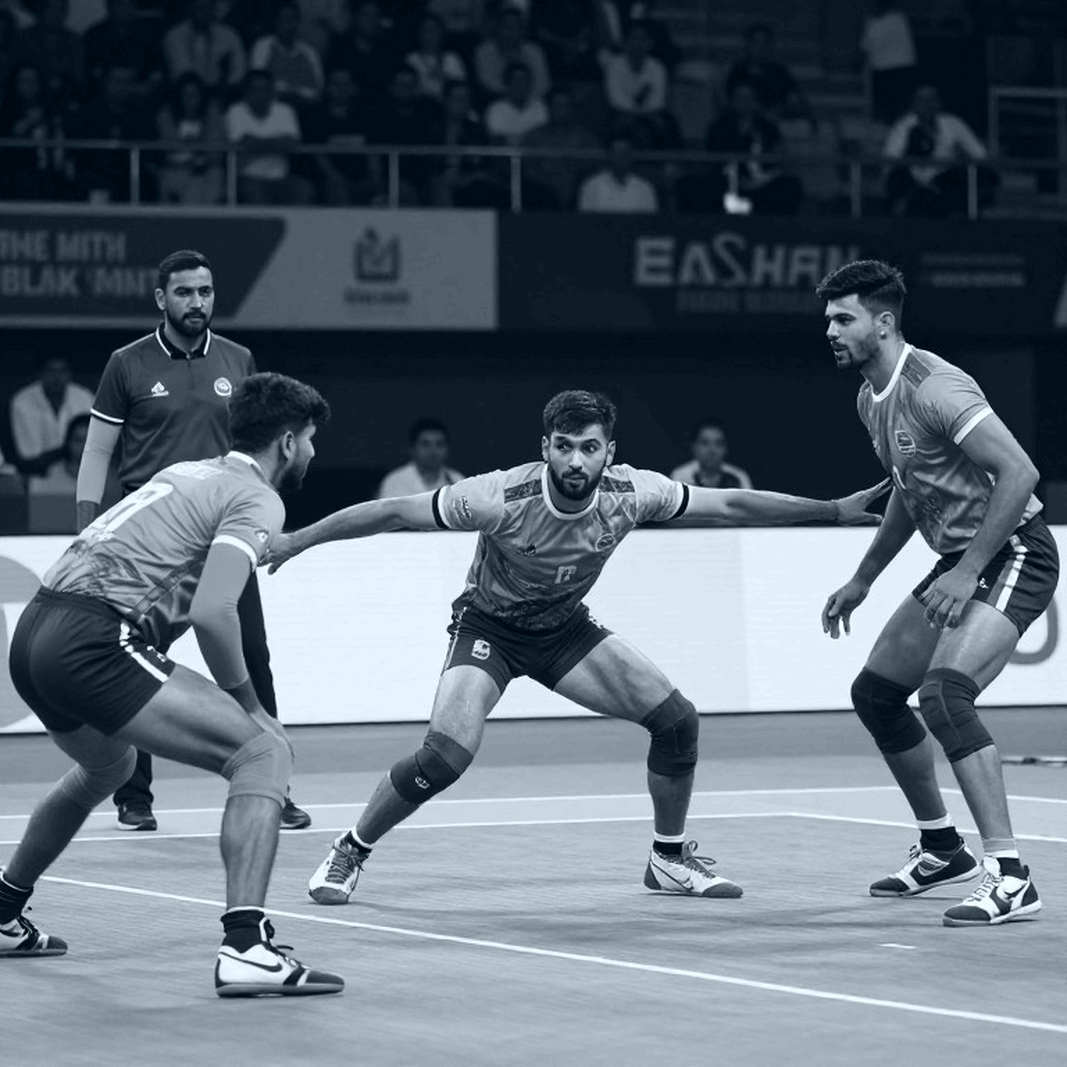
Kabaddi is a 7-v-7 contact team sport in which attack and defence happen inside the same 30-second unit. For readers encountering it for the first time, six basics:
One, the raid. A single attacking player (the raider) crosses into the opponent's half, touches a defender, and must return safely within 30 seconds to score. Think of it as football's one-man breakaway.
Two, the cant. Throughout the raid the raider must continuously chant 'kabaddi… kabaddi…' to prove he is not inhaling. If the chant breaks, the raid is void. The rule is where the sport gets its name.
Three, the tackle. The defending side collectively stops the raider inside their own half — a wrestling-style physical contest.
Four, the All Out. When an entire side is ruled out, the opponent earns 2 bonus points and the whole team revives. This 'team-wipe reset' is the engine behind kabaddi's fast scoring and frequent comebacks.
Five, the Do-or-Die raid. After two consecutive empty raids, the third becomes a mandatory attack — and if it also scores nothing, the raider himself is out. The rule forces conservative teams to take risks.
Six, the Super Tackle. A tackle completed when the defending side has three or fewer players on court is worth 2 points — the reward for desperate last-ditch defence.
46-26, 44-30, 37-23: what the scorelines actually say
India's three totals sit between 37 and 46. In kabaddi that is consistent with normal professional scoring, where repeated All Outs inflate totals. A Circle Style variant — played on a circular field — would produce a different scoring signature. Everything available fits Standard Style: rectangular court, 7 v 7. The source, however, never states this, so it remains a medium-confidence inference.
More important is that in kabaddi, a large margin is not purely a talent effect. The All Out rule means gaps are rule-amplified. Once a team is pinned back, the opponent forces All Out after All Out and the margin widens quickly. Nigeria's 49- and 50-point defeats are a product of that mechanism. That does not mean the talent gap is small — it is plainly very large — but the scoreboard exaggerates the difference in real strength.
Big wins, small margins: India's genuine concern
India's net margins across three games are +20, +14 and +14. They have scored 127 and conceded 79. In a competition where England have put 68 on Nigeria and Tanzania 66, a 14-to-20-point margin is comfortable rather than commanding. Coverage has described India's start as 'with a bang' and the team as 'clear favourites', while conceding in the same breath that India have 'not won by a big margin' and that fans are 'disappointed'. Both things are true at once, and the data leans toward the sceptical reading.
Conceding 23 to 30 points a game is a yellow flag. A genuinely dominant defensive side against this level of opposition would concede less. India's defence looks good enough to win comfortably, not airtight.
The strongest defensive evidence comes from the England game
The sharpest tactical read available from this tournament comes from a cross-reference. England scored 68 against Nigeria. Against India, the same England scored 26. That is a 42-point suppression. It is the strongest available evidence that India's defensive structure is operating at a high level, even though India's own scoring margins look modest.
This is where the surface reading and the deeper reading diverge. The surface reading says: India won by 14, that is underwhelming. The deeper reading says: India held a capable attack to 26 after it had posted 68. Picking either alone would be lazy. The correct conclusion is that India's defence is good, but that the sharpness of the attack cannot be assessed from this data.
Captain Surjeet Singh and the data blind spot
Only one player is named anywhere in the coverage: captain Surjeet Singh. That he is captain is a solid fact. Whether he is a raider, a defender or an all-rounder is not stated. Kabaddi captaincy often goes to a defensive anchor or a tactical leader, but that is speculation, not fact.
The bigger issue is that no player-level numbers exist at all. No successful raid percentage, no tackle percentage, no individual raid points, no bench rotation detail. The direct consequence: we cannot say whether India's attack runs through one star raider or is spread across the unit. That is a data gap, not a clean bill of health, and readers should know the difference.
What can be inferred is limited. India's defensive ceiling is probably higher than the raw 79 conceded suggests, because at least one opponent (England) is a capable scoring side. The captain is likely a senior, stabilising figure rather than a pure statistical star — a low-confidence read that should be treated as such.
Iran's absence: the biggest story in this tournament is the one not playing
One structural fact belongs at the top of any analysis: Iran are not in this tournament. And Iran are the one nation that has genuinely beaten India at the top level — the 2026 Asian Games men's gold is theirs.
Global kabaddi is bipolar: India and Iran. Everyone else sits below. Without Iran, India's run of three wins is a run of wins over tier-2 and tier-3 opposition, and it flatters India's apparent dominance. The reason is simple: Iran are not a Commonwealth member, so they are structurally excluded from this field. That is not a failing of the competition; it is a limit of the format.
The absence of Pakistan and Bangladesh is also notable — both are Commonwealth members with deep kabaddi traditions, especially Pakistan in Circle Style. The source lists only six teams, so it is hard to say whether they are genuinely absent or merely unlisted. Treat this as a low-confidence point.
A three-tier tournament: Nigeria's 17-66 and 18-68
The scorelines map the field cleanly. Tier one: India. Tier two: England, Tanzania, Malaysia, Uganda. Tier three: Nigeria. Nigeria's two defeats, by 49 and 50, define the tier-three floor.
Interestingly, Tanzania and Uganda — usually assumed to be 'developing' African sides — look like big scorers next to Nigeria. That shows tier two is not internally equal either. In Commonwealth kabaddi, 'Africa' is not a single unit; there are levels within it.
The most important upcoming node is an India-versus-England type contest, or a knockout match against a capable side like England. The source does not state whether a knockout stage exists.
From the akhada to the league: kabaddi's cultural base
In India, kabaddi is the most-watched non-cricket sports property, and the Pro Kabaddi League (PKL) is why. Its roots are in the mud of the village akhada, and it is closely tied to government-job pathways — railway, police and army recruitment have long been an established route for kabaddi players.
For a Chinese reader, the closest analogy is the modernisation of a folk-wrestling tradition into a televised professional league. Kabaddi is roughly what happens when a nationally beloved folk sport becomes a pro league.
There is another layer: the word 'Commonwealth'. This is not just a name but a soft-power move — branding kabaddi as a shared sport of the Anglophone world extends its reach into Africa and Southeast Asia. It is India packaging kabaddi as a cultural export.
But the truth is that this internationalisation is broad and shallow. Many flags, very few competitive nations. Nigeria's 49- and 50-point defeats are not a one-off; they are a symptom of that shallowness. India's dominance here is a structural talent-pipeline advantage — rural base plus the PKL professional ecosystem — that no tier-three nation can approach in the near term.
Broadcast, auction and money: this is not the PKL
One thing needs to be stated clearly, because many reports blur it: the Commonwealth Kabaddi Championship is an international national-team event, not a PKL franchise auction. Auction premiums, player salaries and franchise valuations do not apply. Nor is any such data available.
The format of the coverage itself is a commercial signal. What exists is essentially a 'LIVE streaming and telecast guide' — meaning distribution is streaming-led and low-tier. That indicates broadcast-rights value clearly below the PKL or the Asian Games. Demand is real, but the audience base is narrow.
There is no data on sponsorship, rights value or player compensation, so no judgement is possible on that front — insufficient information. The reasonable inference is that an event like this generates negligible standalone broadcast revenue and functions mainly as content plus a soft-power vehicle rather than a commercial product.
Governance: who is running this tournament?
The question should be asked, and the available material does not answer it. Who the organiser is, whether the International Kabaddi Federation (IKF) sanctions it, and what role national federations such as India's AKFI play — none of this is clear. This is not a scandal; it is opacity, and opacity is itself a governance risk.
Two things are clear. First, the 'Commonwealth' label is aspirational, not institutional. Kabaddi is not a Commonwealth Games sport, so this championship does not plug into the Commonwealth Games Federation's programme or its prestige ladder. For readers, that is a prestige-inflation risk: the name can lead people to overrate the event.
Second, the event does not advance kabaddi's Olympic case. Olympic entry requires structural criteria — number of participating countries, continental coverage, depth in the women's game. A thin field with Iran and Korea absent does nothing to close those gaps. This is a development and marketing fixture, not a governance milestone.
Risk: what to watch and what not to assume
The biggest risk here is analytical, not sporting: reading '3-0' as global dominance when Iran are not even on the mat. Weight results by opponent quality, and state Iran's absence alongside every conclusion.
Second risk: conceding 23 to 30 points a game. Against elite raiders, that same defence could look soft. The cross-reference (England 68 against Nigeria, 26 against India) partially offsets this, but not entirely.
Third, what we do not know: does India's attack depend on one star raider? Answering that requires per-player raid points, which are unavailable. Read that as an open question, not an all-clear.
And fourth, structural: tier-three nations are participating but not competitive. That is not their fault; it is a stage of development. But promoters will present it as 'the rise of global kabaddi', while the data shows shallowness.
Conclusion
On paper India are unbeaten and their meeting with Nigeria is one-sided. The truth on the mat is slightly different: India's defence is good, their scoring margins are comfortable, but no conclusion should be drawn without remembering that the one team that genuinely challenges India is not in this tournament. Iran's absence is the biggest story of this championship, even though it appears on no scoreboard.
Day 4 against Nigeria matters not because it will tell us anything new about India, but because it will show how ruthlessly India crush weak teams. The real question will be answered later, the next time Iran are on the other side of the mat.