
Kabaddi
Kabaddi: A Seven-Player Game Decided in Thirty Seconds
प्रश्न: कबड्डी में एक रेड कितने सेकंड की होती है? उत्तर: तीस सेकंड। रेडर को इस दौरान लगातार 'कबड्डी' का उच्चारण करते हुए विपक्षी कोर्ट में जाकर कम से कम एक डिफेंडर को छूना और लौटना होता है। प्रश्न: कबड्डी मैच की अवधि कितनी होती है? उत्तर: दो हिस्से, हर हिस्सा 20 मिनट, बीच में पांच मिनट का विराम। प्रश्न: ऑल आउट पर कितने अंक मिलते हैं? उत्तर: दो अंक, और इसके बाद विपक्षी टीम के सभी खिलाड़ी मैदान पर लौट आते हैं। प्रश्न: सुपर टैकल क्या है? उत्तर: जब कोर्ट पर तीन या उससे कम डिफेंडर बचे हों और टैकल सफल हो, तो उसे सुपर टैकल कहते हैं और यह दो अंक देता है। प्रश्न: डू-ऑर-डाई रेड कब होती है? उत्तर: लगातार तीसरी खाली रेड पर रेडर के लिए अंक लेना अनिवार्य हो जाता है। प्रश्न: कबड्डी कोर्ट का आकार क्या है? उत्तर: पुरुषों के लिए 13 मीटर x 10 मीटर, महिलाओं के लिए 12 मीटर x 8 मीटर।
Kabaddi is often dismissed as a simple game — no ball, no racket, just seven players and one raider who holds his breath and crosses over. That simplicity collapses the moment play begins. The sport demands that body, breath and decision-making be managed at the same time. One wrong step costs a point; one correct read puts an entire team back on the mat. Understanding kabaddi therefore starts with its rules but does not end there; it runs through strategy, fitness and temperament.
The Geography of the Court
The standard men's court is 13 metres long and 10 metres wide; for women it is 12 by 8 metres. A mid-line divides the court into two halves. On each side there is a baulk line, a bonus line, and a narrow strip outside the boundary known as the lobby. Seven players from each side are on the mat, with five substitutes waiting. A match is played in two halves of 20 minutes each, with a five-minute break in between. These numbers are fixed, but the game inside them shifts with every raid. Every part of the court carries a different role: a defender near the baulk line looks to make a quick hold, while the covers are responsible for closing the raider's escape route. The team that reads its own court better is usually the one that does not get dragged into tackles too early.
Thirty Seconds of Raid
A raider gets thirty seconds. In that time he must enter the opponents' court, touch at least one defender, and return. Touching is not the only condition — the raider must chant "kabaddi-kabaddi" continuously. This compulsory breath control is the hardest part of the raid, because the moment the chant breaks, the raid is over. Raiding is therefore never treated as a sprint; it is a decision made while counting breaths.
The raider's options are not limited. A toe touch, a hand touch, a dubki — ducking low and slipping through — or crossing the bonus line for an extra point: each carries its own risk. A bonus point is awarded only when the raider crosses the bonus line while six or more defenders are on the court. But chasing the bonus often draws the raider deep, and that is exactly where the corner defender is waiting. On the other side, a raid that ends without a point is an empty raid; on the third consecutive empty raid the attempt becomes compulsory, known as a do-or-die raid. This rule has all but eliminated the option of a raider simply avoiding contact.
The Partnership of Defence
Half of kabaddi is defence, and half of defence is coordination. Two corners and two covers together build a trap that slows the raider down. A corner defender usually delivers the final tackle; a cover guards the space in front of him so the raider cannot slip through the middle.
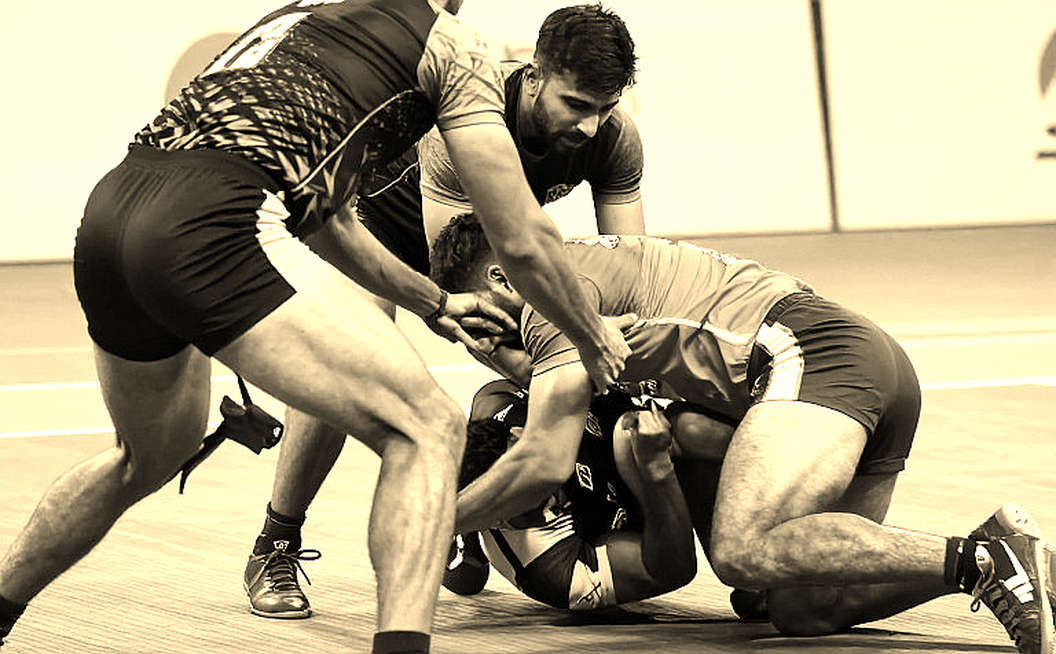
Tackles take several forms — ankle hold, thigh hold, block, dash. In an ankle hold the defender takes control of the raider's leg; in a block he presents his chest and shuts the route. None of these techniques works in isolation. If one defender commits to a tackle and the other two retreat, the raider finds space to escape. That is why coaching emphasises the chain tackle: the first defender stops the raider, the second holds him, the third keeps him pinned inside the court.
The most delicate situation arrives when three or fewer defenders remain on the court. A successful tackle in that situation is a super tackle and is worth two points. This rule keeps the game balanced: even a weakened team can earn two points and get a player back through a single tackle.
The Arithmetic of Scoring
A kabaddi score is not just a count of points; it is a calculation of player availability. When every player on the opposing team is out, an all out is declared, two points are awarded, and all the opponents' players return to the mat. This is why a lead in kabaddi is never considered safe — in two minutes both the score and the balance of the court can change.
Taking three or more points in a single raid is a super raid. This usually happens when a raider touches several defenders in succession and gets out. Such a raid turns the course of a match, because it brings points and simultaneously reduces the opposition's numbers. The modern game has also added a review system, allowing doubtful tackles or outs to be checked. It has reduced the pressure on referees somewhat, but it has also slowed the game a little.
The Load on the Body
The fitness demands of kabaddi are no lighter than those of any contact sport. A raider needs explosive speed — three or four strides to reach a defender and the same speed to turn back. A defender needs stability — he absorbs a raider arriving at full force, and falling is routine. Both require core strength, ankle stability and balance.
Breath control is the distinctive demand of this sport. Running while chanting continuously and absorbing a tackle is a capacity that ordinary cardio does not build; it is trained separately with breath-holding drills. The injury risk is also high: knees, ankles and shoulders take the most damage, because in a tackle the body's full weight suddenly lands on a single joint.
The League Changed the Face
Launched in 2026, the Pro Kabaddi League carried the sport from mud courts to mats and television. Three things changed with it. First, players gained recognition and financial security. Second, coaching became professional — video analysis, study of opponents' habits, and work on tackle patterns began. Third, broadcast reached different states, widening the talent pool.
The league turned a few names into household words. Raiders such as Anup Kumar carried teams to titles, Pardeep Narwal's raiding became a talking point, and foreign defenders such as Fazel Atrachali showed that the sport was no longer India's alone. The participation of overseas players also made international contests tougher.
The International Picture
Kabaddi's roots lie in rural India, but its organised competitive history is relatively recent. After the sport was included in the Asian Games in 2026, India's dominance lasted a long time. Iran challenged that dominance in later years with strong defence and disciplined raiding, and international contests are no longer one-sided. Countries such as South Korea, Bangladesh and Thailand have also improved their levels. Competition has expanded in the women's game as well, and the case for women's participation in the domestic league is now being argued seriously.
The Road Ahead
Kabaddi faces three clear challenges. First, injury management — as the density of the season rises, the load on players grows and recovery time is short. Second, the use of data — many teams still decide on instinct, even though raid and tackle data is available. Third, continuity at the grassroots — the league's shine will reach village and school akharas only when players coming from there have a visible pathway.
Kabaddi's real strength is its simplicity: one raid, thirty seconds, one decision. But that same simplicity places it among the hardest sports, because here every player must think, run and endure at once.

संबंधित खिलाड़ी
लोकप्रिय/पसंदीदा पुस्तकें
The Modern Science of Kabaddi: Rules, Strategy and the Ecosystem Explained2026-10-31
Reputation Wrote the Headline, the Data Wrote a Different Ending: A Forensic Audit of Indian Kabaddi's Price List2026-10-30
From Mud to Millions: Kabaddi's Transformation and India's Enduring Dominance2026-11-01
Four Golds, Zero Leagues: The Ledger Women's Kabaddi Keeps Off the Scorebook2026-11-01
Kabaddi's Second Decade: From the Mat to the Market, and Back2026-11-01
Before the Lights: Kabaddi's Two Worlds and One Ledger2026-10-31
Kabaddi: A Seven-Player Game Decided in Thirty Seconds2026-10-31
39 vs 23 in Ahmedabad: The Real Scorecard of the Commonwealth Kabaddi Championship2026-10-30
अनुशंसित
Commonwealth Kabaddi Championship 2026: The Mat Is Being Laid in Ahmedabad, but the 'Where to Watch' Answer Isn't There Yet2026-10-26
The Signal Buried in the Fixture List: When Raid Success Falls, the Raider Is Not the Culprit2026-10-27
The Day-1 Table Is Measuring the Format, Not the Teams: Commonwealth Kabaddi Championship 20262026-10-30
41 Tackles, 33 Planted Feet and One Ankle: The Real Mechanism of Kabaddi Injuries2026-10-25
The Modern Science of Kabaddi: Rules, Strategy and the Ecosystem Explained2026-10-31
Commonwealth Kabaddi Championship: The Truth About the Women's Draw Is Buried in the 62-Match Schedule2026-10-24
Before the Lights: Kabaddi's Two Worlds and One Ledger2026-10-31
Four Golds, Zero Leagues: The Ledger Women's Kabaddi Keeps Off the Scorebook2026-11-01
अनुशंसित
The Day-1 Table Is Measuring the Format, Not the Teams: Commonwealth Kabaddi Championship 20262026-10-30
Four Golds, Zero Leagues: The Ledger Women's Kabaddi Keeps Off the Scorebook2026-11-01
India vs Uganda, Match 9: The Defensive Crack Inside a 46-26 Win — and the Real Status of the 'Commonwealth' Championship2026-10-25
Not 46 — Look at 26: The Real Story Behind India vs Uganda2026-10-25
Commonwealth Kabaddi Championship 2026, Day 1: An Honest Scorebook, A Misleading Table2026-10-25
Before the Lights: Kabaddi's Two Worlds and One Ledger2026-10-31
From Mud to Millions: Kabaddi's Transformation and India's Enduring Dominance2026-11-01
Reputation Wrote the Headline, the Data Wrote a Different Ending: A Forensic Audit of Indian Kabaddi's Price List2026-10-30
अनुशंसित
Commonwealth Kabaddi Championship: The Noise of India's Three Wins, and the Arithmetic of Iran's Absence2026-10-30
Commonwealth Kabaddi Championship 2026: The Mat Is Being Laid in Ahmedabad, but the 'Where to Watch' Answer Isn't There Yet2026-10-26
62 Matches, Nine Days and Three Missing Women's Teams: The Ahmedabad Ledger Nobody Opened2026-10-26
Commonwealth Kabaddi Championship 2026: Before India vs Uganda, the Real Story Behind the 46-26 and 45-29 Scoreboards2026-10-30
Commonwealth Kabaddi Championship 2026, Day 1: An Honest Scorebook, A Misleading Table2026-10-25
Before the Lights: Kabaddi's Two Worlds and One Ledger2026-10-31
The Signal Buried in the Fixture List: When Raid Success Falls, the Raider Is Not the Culprit2026-10-27
Auditing India's Depth in Ahmedabad: Match 4 of the Commonwealth Kabaddi Championship2026-10-30