
होमAsian CricketHarmanpreet's century, Mandhana's standing ovation and India's strong recovery to 328/6
Asian Cricket
Harmanpreet's century, Mandhana's standing ovation and India's strong recovery to 328/6
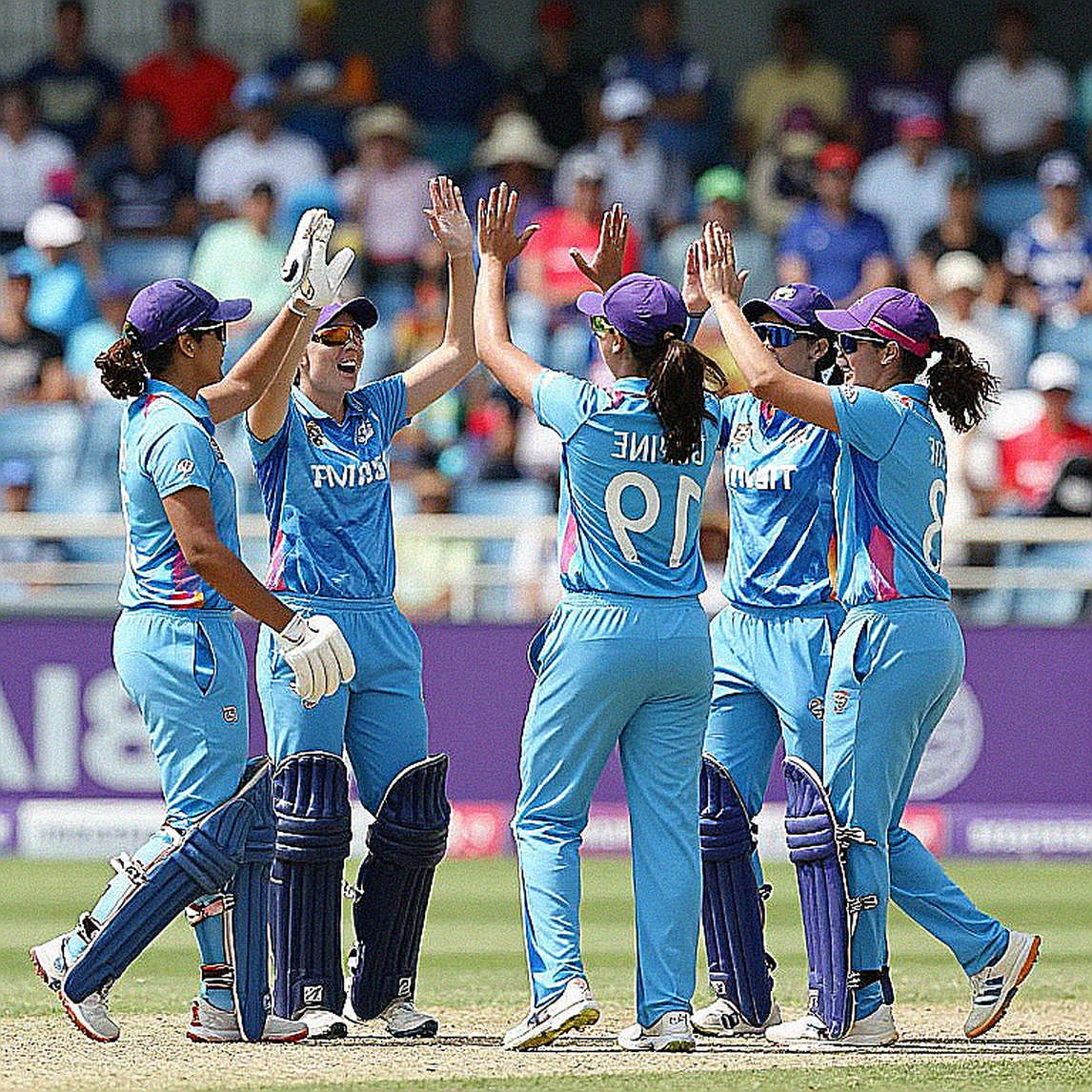
वडोदरा में भारत ने जिम्बाब्वे के खिलाफ पहले महिला वनडे में 328/6 बनाया। हरमनप्रीत कौर ने 121 गेंदों पर 126 रन बनाए और 101 गेंदों पर आठवां वनडे शतक पूरा किया। स्मृति मंधाना ने शतक पर खड़े होकर तालियां बजाईं। हालांकि हरमनप्रीत के तीन कैच छूटे, इसलिए इस पारी को फॉर्म का अंतिम प्रमाण न मानें। भारत की टॉप-ऑर्डर शुरुआत कमजोर रही, जबकि दीप्ति शर्मा ने 106* और प्रतिका रावल ने 61 रन बनाए।
Vadodara. The first match of the women's ODI series between India and Zimbabwe was special in many ways. It is the first-ever bilateral women's series between the two countries, and in the very first game India posted a strong 328/6. The biggest story of the innings was Harmanpreet Kaur's superb century. Harmanpreet made 126 off 121 balls and completed her eighth ODI century. She reached the hundred off 101 balls and then added 26 runs off the final 20 deliveries to put India in a commanding position. As soon as Harmanpreet completed her century, Smriti Mandhana was seen standing and applauding in the dressing room. The moment was seen as a sign of harmony under the new captaincy setup.
India did not get a good start. In the opening over, Smriti Mandhana was caught off a mistimed pull, while Shafali Verma was caught at mid-wicket cheaply. The early dismissal of both openers put the team under pressure. Mandhana was leading the side for the first time, and her early exit was a signal worth tracking through the rest of the series. However, India's middle order then took charge and lifted the team to a big total.
Pratika Rawal and Harmanpreet steadied the innings. Rawal made 61 off 67 balls and shared a 124-run partnership with Harmanpreet. After that, Deepti Sharma batted aggressively and made an unbeaten 106 off 86 balls. Harmanpreet and Deepti shared a 153-run stand that carried India to a big score. Deepti's strike rate was around 123, while Rawal's was about 91. These two partnerships showed that India's middle order took responsibility after the early jolts and took the team to 328/6.
A key feature of Harmanpreet's innings was her acceleration. After making 100 off 101 balls, she added 26 off the last 20 deliveries. Her overall strike rate was around 104, which is above the typical elite benchmark in women's ODI cricket. According to the report, she scored through off-side shots such as the cover drive and cut. This shows she first built a platform and then increased the tempo in the closing overs. It was a sign of experienced batting, where a batter holds the innings together before accelerating.
However, there is an important caveat. Three catches were dropped off Harmanpreet. This means the 126-run figure may slightly overstate the technical difficulty she overcame. Treating it directly as proof of a return to form would be premature. The match also reflects the gap between India and Zimbabwe. India are an elite women's team, while Zimbabwe are an emerging side. A big score here does not necessarily mean India's batting will be equally strong against stronger attacks.
The early wickets raised questions about India's top-order fragility. Both Mandhana and Shafali were dismissed cheaply. It happened against a weaker attack, so it should not be treated as a major problem immediately, but it must be tracked across the series. If the openers keep falling early, it could become a concern. The good news for India is that the middle order rescued the team, but the top order will need to find rhythm over the longer term.
For Zimbabwe, this series is a big opportunity. For the first time, they have a bilateral series against a strong team like India. Nomvelo Sibanda took two wickets in this match and could be a player to watch in the remaining games. For India, the series is also a platform to test new captaincy and new combinations. Playing at home is an advantage, but the report does not provide much detail about pitch behaviour or weather. A total of 328/6 is generally a big score in women's ODI cricket, but before calling it purely a batting effort, the quality of bowling and the conditions must be considered.
Mandhana played as captain for the first time, while Harmanpreet batted without the responsibility of captaincy. Some analysts see this as part of a generational transition. However, one match cannot prove that the change is fully successful. Mandhana standing and applauding in the dressing room is a positive sign, but it should not be turned into a larger conclusion. Pressure on a new captain is natural, especially when the top order stumbled in the first match.
The match carries no direct commercial or league signal. It is an international bilateral series, not a franchise league. From the point of view of growing women's cricket, giving Zimbabwe an opportunity is positive. Indian players are part of the WPL, so such innings can influence league narratives later, but this report does not provide direct data on that. No governance controversy surfaced. There is no mention of a DRS, DLS or over-rate dispute. The captaincy change is a board-level decision and is seen as low risk.
The main risk is viewing the century without context. Three dropped catches, a weaker opponent and home conditions must all be kept in mind. The second risk is top-order instability. The third is the pressure building on the new captaincy. If the openers continue to fall early and the middle order has to do most of the scoring, it could become a major talking point after the series.
Overall, Harmanpreet's eighth ODI century and India's 328/6 are the biggest headlines from the first match. Deepti Sharma's unbeaten 106 and Rawal's 61 show the strength of the middle order. But the real test will come in the remaining matches and against stronger attacks. The signal for India is clear: the middle order rescued the team, but the top order and the new captaincy need time. For Zimbabwe, the experience is valuable for the future, while for India the series is a chance to assess the new leadership and batting combinations.
संबंधित खिलाड़ी
लोकप्रिय/पसंदीदा पुस्तकें
The January Window: Asian Cricket's Real Transfer Market Is Locked Inside an NOC File2026-11-01
The Empty Filing Room: When a Cricket Story Reached the Desk With No Headline, No Source and Not One Information Point2026-11-01
The Empty Scorebook Audit: Where Asian Cricket Loses Its Numbers2026-11-01
Dubai's Empty Press Box: Who Is Still Writing Asian Cricket's Record2026-11-01
The New Geography of Asian Cricket: From Asia Cup Politics to the Rise of the Associates2026-11-01
Eight Sections, Zero Information: How Cricket's Data Desk Sends an Empty Report Out Labelled 'Ready'2026-11-01
The Verdict on an Empty Frame: Evidence, Noise and the Honesty of Asian Cricket's Replay Desk2026-11-01
'Not Doing Justice to Their Talent': Yuvraj Singh Wants Abhishek Sharma and Vaibhav Sooryavanshi in the ODI Setup2026-11-01
अनुशंसित
Jai Moondra's 6/26: the real story is 26 runs in 10 overs, not the six wickets2026-11-01
New Zealand End India's Unbeaten Run, But the Record Story Has Gaps: Format, Venue and Scoreline All Missing2026-10-31
The Empty Payload, The Full Confidence: Auditing Cricket Data's Silent Failure2026-10-31
Who Replaces Ishan Kishan? The Question Is the No. 5 Slot, Not the Name2026-10-25
Pollard as MI Head Coach: 189 Matches, 69 Wickets, and a Vacancy With No Queue2026-10-25
'Not Doing Justice to Their Talent': Yuvraj Singh Wants Abhishek Sharma and Vaibhav Sooryavanshi in the ODI Setup2026-11-01
Mahfizul Islam Robin's 'Another Century', and the Empty Column Nobody Fills2026-10-25
Why Nobody Says Kuhnemann's Name: The Real Question Inside Australia's Test Selection Debate2026-10-26
अनुशंसित
Pakistan's Emerging Nations Trophy Squad: New Captain, Same Questions — 14 Players, 8 Matches, and a Release That Never Names the Format2026-10-28
Pollard as MI Head Coach: 189 Matches, 69 Wickets, and a Vacancy With No Queue2026-10-25
Shaheen's Admission and Lahore's Question: Which Date Is Pakistan's Top Order Waiting For?2026-10-31
A Cricket Label, A Furniture Fair: The Match That Wasn't There at Bashundhara2026-10-30
Mumbai Indians' Backroom Audit: The 'Consultant' Title, the Development-Squad Mandate and the Incomplete Evidence of Nitish Kumar Reddy's Pace Jump2026-10-25
Babar Azam's 45 and 34: Not Three Weaknesses, One Footwork Flaw — and the Quiet Truth of Rawalpindi2026-10-26
Asia Cup 2026: How One Dubai Ground Became the Whole India–Pakistan Record2026-10-29
Empty Payload, Green Status: The Costliest Leak in Cricket's Data Supply Chain2026-10-27
अनुशंसित
Mushfiqur Rahim's Finger and the Mirpur Toss: Bangladesh Have Hope, Not a Scan2026-10-28
A Fifty in 14 Balls: Suryavanshi and Abhishek's Powerplay Storm, and the Six Overs the Scorecard Never Got2026-10-30
Harmanpreet's century, Mandhana's standing ovation and India's strong recovery to 328/62026-10-27
Djokovic Makes History: Becomes Tennis' All-Time Great with 25th Grand Slam Title2026-10-27
Ishan Kishan Out, Tilak Varma at No.3 — and the Question No Headline Asked: Who Takes the Gloves?2026-10-25
Shamar Joseph's Stomach Upset: West Indies' Narrowest Door in Mirpur2026-10-24
Another Century for Robin: 500 NCL Runs, the Average Nobody Printed, and the Uncounted Labour of Domestic Cricket2026-10-25
D3 Trophy Auction: Tanjid's 2 Crore, Mustafizur's 70 Lakh, and the Price of Availability Hidden Between Them2026-10-30